My blog post became a comedy series
A few years ago, I wrote a blog post about my experiences in the Viking re-enactment community and why I left. The creators of “Vikings VS Nazis” contacted me after reading it. Now, the experiences that led to my departure have helped inspire a comedy.
First, a little about the premise of “Vikings VS Nazis”:
In chieftain Leif Petter’s Viking camp, everyone is welcome, because at a Viking market, it doesn’t matter who we are on the outside. Or, as Leif Petter puts it: “Attitudes, ideologies and any childhood traumas—we leave those at the entrance. Here, we’re just ourselves, united by the fact that we’re all Vikings.”
This year, Leif Petter has invited some new Vikings to the market, some real tough guys. They quickly turn out to be neo-Nazis. Surely that ought to cause a few problems for this project? But Leif Petter, who is, after all, a socialist and votes for Norway’s Socialist Left Party, holds on to his dream of a harmonious community. Shouldn’t the Nazis be given a chance too? Isn’t exclusion precisely what breeds extremism?
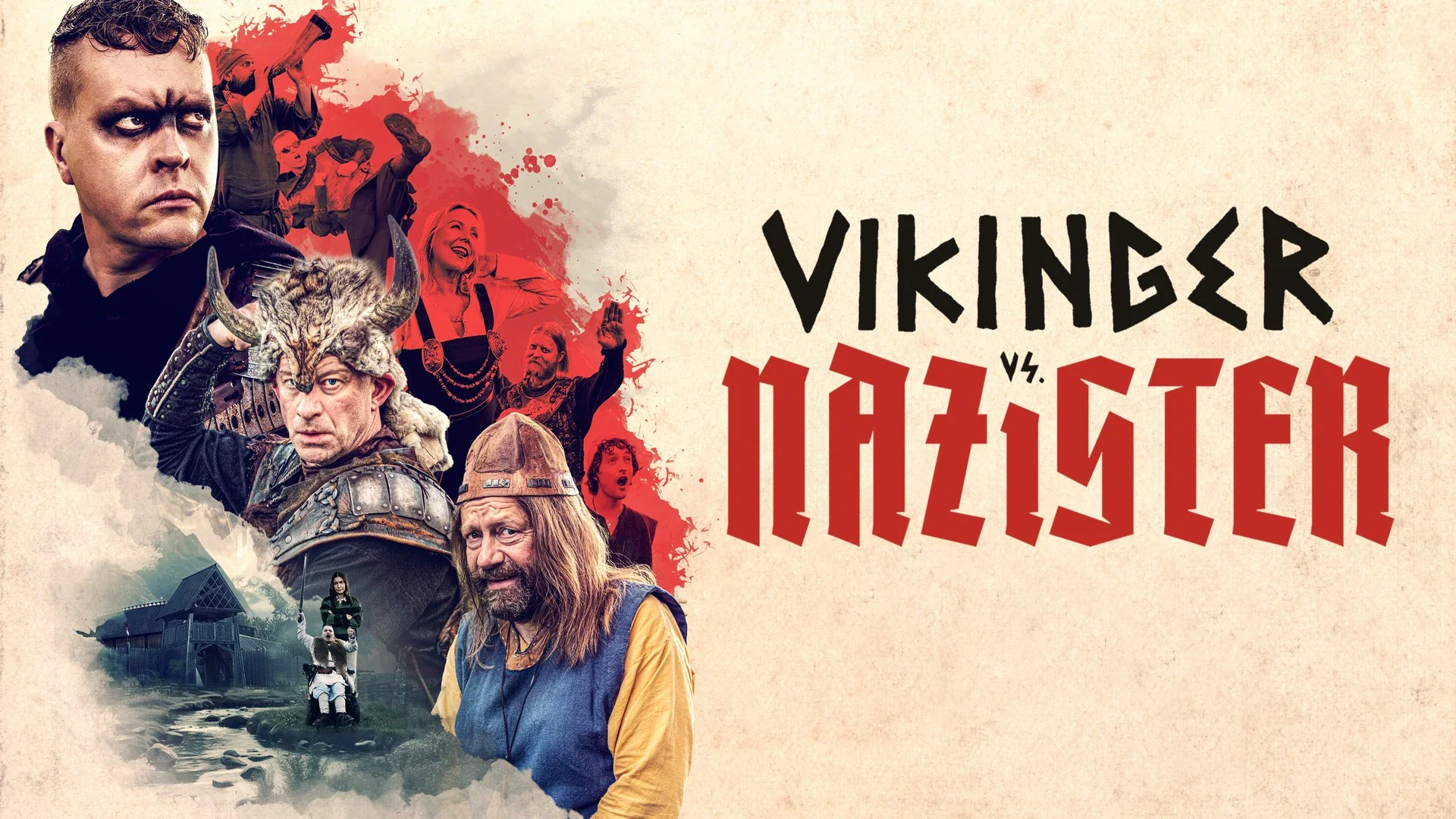
Image: NRK - National Norwegian Television
I laugh. And remember that I’ve been part of a few versions of this encounter before. Because although both the Nazis and the “Vikings” in the series are heavily caricatured, it captures the very issues I grappled with a few years ago.
When I was active as a Viking in the re-enactment community, I spent a lot of time defending myself and the community against prejudice and misconceptions. At times, I felt ashamed—“guilty by association.” Eventually, I had to admit that some of what I was defending us against actually existed among us.
An entire community cannot be held responsible for the far right’s misuse of history and symbols. Nor was I responsible for far-right extremists stealing photographs of me and my son from my blog and using them to promote racist and Nazi content. Still, I blamed myself for a long time. After all, I had posed in “Viking clothes at sunset” and unwittingly supplied images for a fascist aesthetic and propaganda about an Aryan past. I felt tainted by having my image used to endorse something I rejected. The misuse of the photographs took the joy out of the project, and I felt a strong need to say: This is not me. These are not my views.
At the same time, I struggled with something the scene could actually take responsibility for: what we tolerated within our own community. I felt that the desire to keep things friendly, preserve friendships and maintain the idea of being apolitical could make it difficult to challenge people’s views. This was far more subtle than what the series portrays. If someone turned up at an event “dressed as a Nazi,” they would, of course, be turned away or thrown out. It was harder to agree on where to draw the line when those views came from someone we knew, dressed in Viking clothes.
Several people were reluctant to discuss what collective steps we could agree on to set boundaries. That would make the community political, something nobody wanted it to be. I met people who rejected far-right extremism but were nevertheless reluctant to draw a line. Pointing out the problem could be seen as more divisive than the views being challenged.
Couldn’t we just be Vikings and have a good time?
I understand what Leif Petter wants. I wanted the same thing for many years. The Viking camp is meant to be a refuge and a place to belong. Here, people who struggle to find their place elsewhere can become part of something bigger. There is a great deal of care in that ambition. That is precisely why it can be difficult to acknowledge that the community also needs boundaries.
And there are several layers to this. The Viking camp becomes a microcosm in which we can recognise dilemmas from wider society. Leif Petter’s belief that everyone can come together if we are simply open and inclusive enough contains both compassion and naivety. What happens when the desire to give everyone a place makes us unwilling to set boundaries for those who would deny others that same place? This is the paradox of inclusion, distilled into a Viking market.

While Leif Petter dreams of a harmonious community where everyone can put their differences aside, the Viking Magnar is concerned with making everything authentic. No modern objects must be allowed to break the illusion of the Viking Age. I can recognise myself in both Magnar and Leif Petter. In their different ways, they are trying to create a world where the troublesome present can be kept outside. An autonomous zone, an escape from reality.
But Magnar also enforces an entirely different form of exclusion. Everything modern and “inauthentic” must go. The camp must be purged of anything that does not belong in his vision of the Viking Age. This applies not only to mobile phones, cigarettes and water bottles, but also to the Red Cross, wheelchairs and glasses. It is precisely this combination that the series captures so well: the reluctance to set boundaries around people’s views, coupled with a strong determination to decide who and what is allowed to be visible.
This is where the encounter between Magnar and the Nazis takes on an unsettling resonance. They may want entirely different things, yet still find common ground in the language of purity and what must be removed.
In this way, the pursuit of authenticity can become a pretext for other motives. I sometimes found it difficult to tell whether someone was defending historical knowledge or using history to defend their own assumptions and attitudes.
I witnessed a participant with a prosthetic limb being asked to leave the battlefield. The reason given was that the prosthesis clashed with the historical appearance. At the same time, derogatory comments were made, dressed up as humour: this person was no real Viking and would never have survived in the Viking Age anyway. The demand for authenticity thus also became a judgement about who had any business being there. In the same way, ideas about historical gender roles were used to give present-day misogyny a historical alibi. And in certain parts of the community, a culture developed in which attitudes that would otherwise have been challenged were given room to flourish.
In the part of the community I belonged to, extremely strict standards were enforced for clothing and equipment. There was far greater uncertainty when it came to setting standards for the attitudes of the people wearing them. We paid closer attention to the details than to the community we were creating.
I missed this kind of wry perspective when I was part of the community: the ability to see ourselves from the outside, ask uncomfortable questions and laugh at our own contradictions. I spent a lot of energy protesting against Vikings and Nazis being mentioned in the same breath at all. I was afraid the juxtaposition would confirm every prejudice I was trying to counter.
Perhaps the series will help more people recognise the dynamics I was reacting to.
I am still in touch with several people who are active in the Norwegian Viking community, and this summer I visited both Birka and the Viking camp at Midgardsblot. My impression is that the community itself has made a serious effort to confront much of this. Perhaps that is also why there is room for a comedy series like this now.